GloBI Symposium MIT
Introduction
Last week, I travelled to America,Boston, to be precise. I was quite worn out, having just arrived from home. I hadn’t had much time to settle in, but despite this, I was excited about the symposium I was due to attend and the opportunity to explore a new city. However, I couldn’t help feeling a little concerned, as the region was experiencing one of the worst blizzards in recent years. Temperatures were between −17 and −20 degrees Celsius. Anyway, that’s beside the point, lets get back to the reason for my visit to Boston.
The GloBI Project
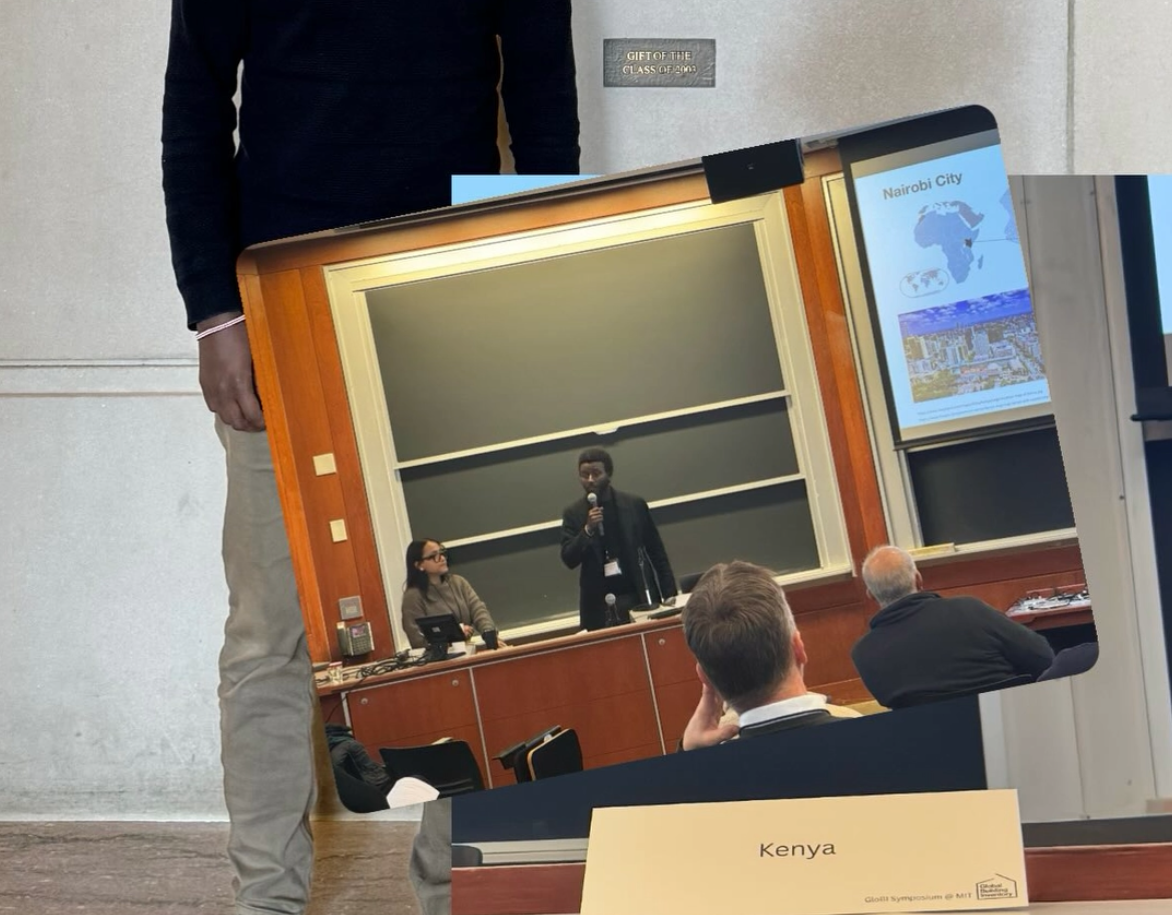
Over the last week of January, I had the opportunity to visit MIT to take part in a workshop titled GLoBI (Global Building Inventory). The symposium was part of ongoing research geared towards democratizing access to granular building energy consumption data for climate action. I was representing Nairobi and had the chance to present a use case for the city. As a rapidly growing city experiencing immense, largely unregulated urban expansion, Nairobi needs strong policies to safeguard the majority of residents who are vulnerable to the effects of climate change. In 2024, global temperatures officially crossed 1.5°C above pre-industrial levels. This spells danger for humanity but poses double jeopardy for cities in the Global South, Nairobi included. With a swelling urban population, millions of residents will be exposed to the effects of extreme weather attributable to climate change. Unfortunately, Nairobi lacks the resources to swiftly adapt to these new realities. As one of the most unequal cities in the world, it is high time we go back to the drawing board and ask hard questions: How can we, as a city, brace ourselves for an inevitably harsher future? How can we ensure that the mama mboga and the innocent infant in Mukuru kwa Njenga or Kibera are safeguarded against the severe effects of extreme weather? The answer lies in policy.; formulating policies that ensure the city’s growth and trajectory follow a sustainable path. The Nairobi Action Plan (2000–2050) clearly outlines the need to climate-proof Nairobi’s housing stock and to ensure a clean and sustainable energy sector. The now six-year-old document highlights actions such as the development of energy performance certificates (EPCs) for all buildings and establishing baseline energy consumption data; however, little has been done so far. When I first joined the GLoBI project, I was quite excited to hear the lead professor, Christoph Reinhart, reiterate that a key goal of the project is to ensure that the datasets generated are open source. This means researchers and stakeholders in Nairobi will have access to rich data enabling advanced and granular urban analytics, which can or will in turn influence evidence-based policy to climate-proof building stock and improve adaptability to an increasingly warmer future. The discussions were deep, eye-opening, and cross-cutting. Two main themes emerged: decarbonization and retrofitting, and human health and climate change adaptation. One of the key takeaways for me came from the simulation workshop on day one. The pipeline developed by Christoph, Sam Wolk, Darya, and the team, which enables the simulation of thousands of buildings, was particularly impressive. It was also interesting to see use cases from different countries and realize how divergent our immediate priorities are, even though we are all ultimately working towards a more robust and resilient built environment.
My Presentation
For my presentation, I aimed to demonstrate how the GLoBI dataset could unlock opportunities and help the NCC and many other Global South cities formulate data-driven policies informed by empirical evidence. I showcased a case study illustrating how unregulated urban sprawl and densification have exacerbated the urban heat island effect in Nairobi neighborhoods. Furthermore, I presented a pilot case assessing thermal autonomy and passive survivability of two office buildings under current and projected climate conditions. The analysis involved a seven-day simulation during an extreme weather event in mid-February, typically the hottest period in Nairobi. The HVAC systems were turned off, and natural ventilation was used for the building with operable windows, with a reasonable allowance for leakage in the building without operable windows. The aim was to demonstrate that the shift in architectural design towards glass-clad buildings in Nairobi is not only increasing energy demand, but also reducing productivity, negatively impacting human health due to overheating, and most importantly weakening the adaptive capacity of buildings to an inevitably warmer future. Nairobi presents a critical case that requires closer analysis. As a leading regional hub, many East African countries look to us for direction; therefore, we must lead by example. This means allocating more resources and research to ensure the city has the necessary mechanisms to adapt to future climate conditions and the evolving needs of its residents. Currently, the city is grappling with dilapidated utilities, severe unregulated development, extreme inequality, the absence of comprehensive development blueprints (master and spatial plans), and poor enforcement of existing policies. Notably, it was only in 2024 that a new building code was enacted; the first since 1968. Additionally, Policy formulation must outpace urban growth and expansion, and it must reflect both present and future needs. A bottom-up approach, where community participation is meaningful rather than symbolic, is essential and it must be geared towards protecting vulnerable and marginalized groups.
Other works
I am currently working on a conference paper connected to my PhD. The paper examines the evolution of urban morphological parameters in Nairobi and their impact on heat stress. It is scheduled to be presented at the end of March. Alongside this work, I am also developing a heat-adaptive architectural design for an ongoing competition in which I participated between July and November 2025. I was selected as one of ten nominees invited to further refine the design. If my proposal wins, it will be presented at the upcoming COP in Türkiye. The deadline is approaching fast. I need that out of my table.
Weekly Objectives
- Prepare slides for SDG meeting on 4th/February
- Prepare Slide for Environmental design lecture earlier next month
- Finish HAAD design and presentation board
- Analysis for the Conference paper and PPT slides